

snow
winter wars
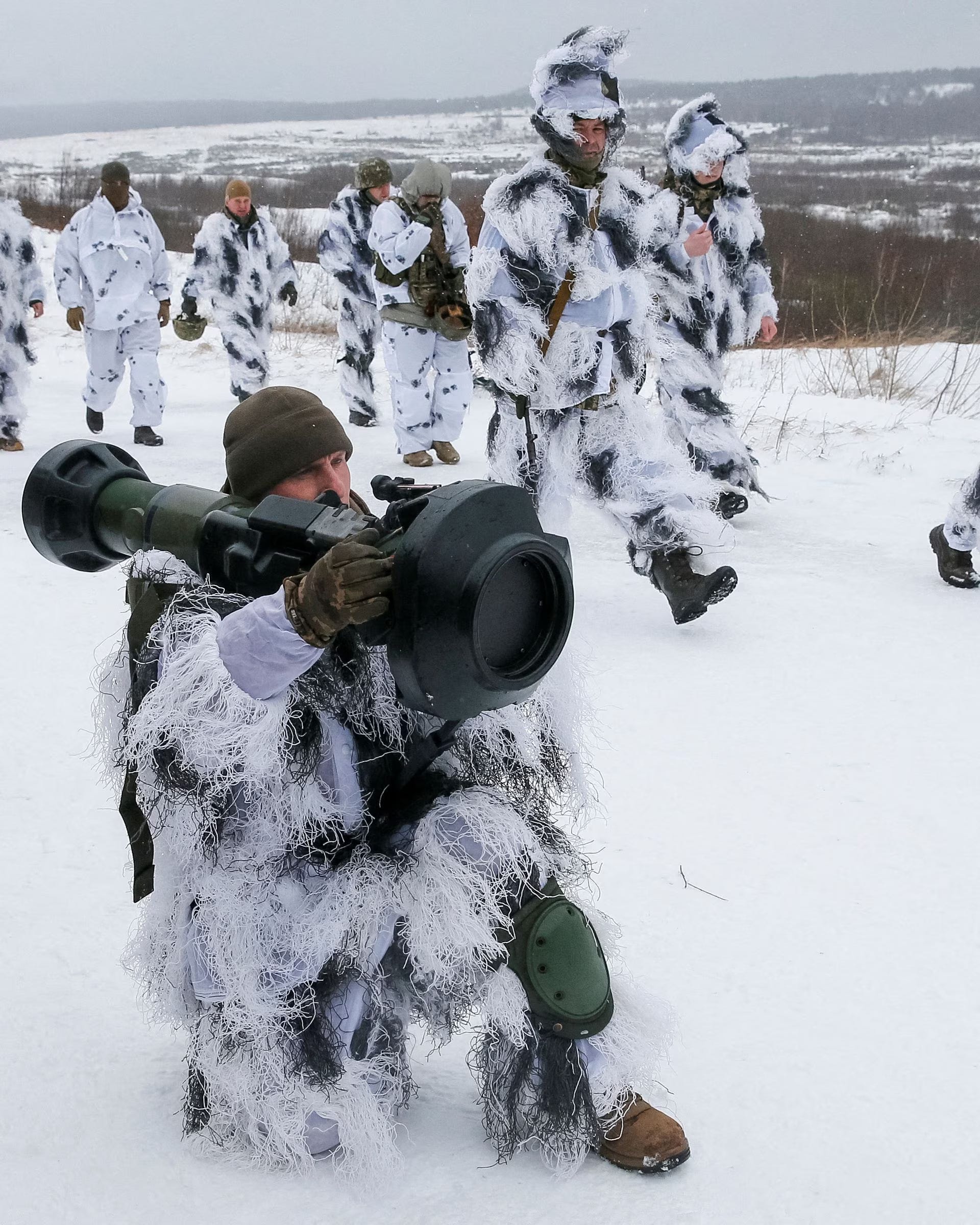
Ghillie suits may be as old as the heather-covered hills of Scottish estates, but they are still used, in this case in Ukraine, where it is critical to disappear into the environment. No longer a slim sniper’s rifle, weapons of a different size, weight and calibre indicate something of the scale of Ukraine’s winter front.
Generally, camo suits are lightweight covers over regular uniforms, in this case, white and black fibres tied onto a mesh cover, impossible to focus on, so diffuse is the outline. Farther back is a plain winter camo cover, likely nylon, printed with blotches. As this is a training exercise in the photo, no one is actually shooting at this formation. If they were, we wouldn’t see anything.

Clearly there are backstory industries going on in Ukraine, of which we hear little. There are also many commercial manufacturers of winter camouflage throughout the north, this one from Finland:

Each army seems to have its own winter camo strategy, many of which are being supplied to Ukraine. This from Lithuania:

Norway:

Canada:

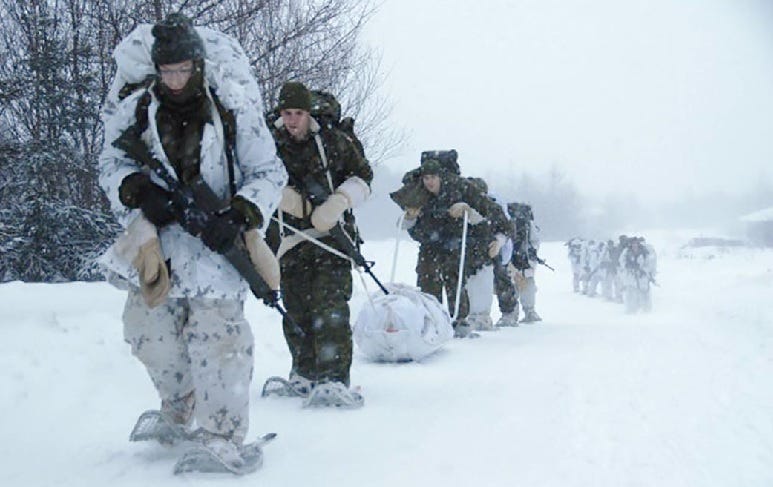
It occurs to me at this point that there are so many winter conditions: forest, grassland, glaciers, arctic tundra – trees, scrub, snowdrifts, windswept rock. How specific must winter camouflage be?
Russia:

And to return to Indigenous ways of winter, as a kind of corrective to all this militarism, John Tyman’s old-style website on the Inuit, specifically a section on clothing:

Such fur and hide clothing is not about war, or the squandering of resources, or lives. It doesn’t cope with invasions or weapons; survival is a condition of climate and millennia of learning an environment. For hunting, invisibility is about stillness, quiet and stealth.