

ledgers
counting and recording


Mniconjou: the Battle of Little Big Horn, 1876
Unlike the linear arrays of a certain kind of depiction of war, battles and their aftermaths, this set of 26 ledger drawings uses an entirely different narrative form. The whole set is held at the Smithsonian and charts the Battle of Little Bighorn in 1876. There is an accompanying text by Mniconjou, a Lakota chief who was there. Both the listings and the drawings were by Red Horse, chief of the Miniconjou of the Teton, at the Cheyenne River Agency in 1881. They were done at the request of a Dr. McChesney, an army doctor at Fort Bennet collecting material for a study of Plains sign language. Known generically as ledger drawings, as they were done in blank ledgers, often with ruled pages, columns and black and red accounting pencils, this set is on blank paper with an array of coloured pencils, which makes them unusual.
These drawings depict in terrible detail the wounds and mutilations on both sides – horses die, heads and hands are chopped off – this is ghastly warfare. But then all warfare is, and it reminds one that most of us, who have never been in a war, despite the statistics on deaths in Syria, Haiti, and the photographs from Ukraine, do not actually see the physicality of the numbers: these drawings are a record of the number of horses, the specific Sioux warriors, the number of teepees in the village being charged by the cavalry, the size of the US cavalry, its horses, saddles, horseshoes, the weapons, the site of wounds, the deaths. They are, literally, ledgers.

The US Army troops are undistinguishable: they have beards, blue trousers, black hats; their horses wear saddles. The Lakota nation however is drawn in beautiful detain, the different war bonnets carefully counted, the shields inscribed with totems. The army is a homogenous unit; the Lakota are individuals, carrying their family histories with them. And what of the horses. They die as well, their saddles gone just as the army dead have lost their boots.
The compared to paintings and drawings flatten the space of war into a representative frieze, these ledger drawings are simultaneously profile and plan. The top of the page is no less important than the middle or the bottom, all participants are equal in size – there is no re-scaling to fit any laws of perspective. We have been taught that renaissance perspective gives a scene veracity: distance blurs, makes dim and small. In these ledger drawings the veracity is more overwhelming, everything is foreground, everything is heroic, nothing is diminished for 'art'. The frieze drawings gain their power in presenting the line of soldiers, or police, as a clear middle ground with no ameliorating fore or back grounds. The ledger drawings present similar lines but many of them, and all in the same space of the page showing rank after rank of cavalry and warrior riding toward each other and clashing violently.
The full set of 26 is both breathtaking and sobering: a tragedy drawing in careful detail, after the fact.

The Goodwyn Ledger
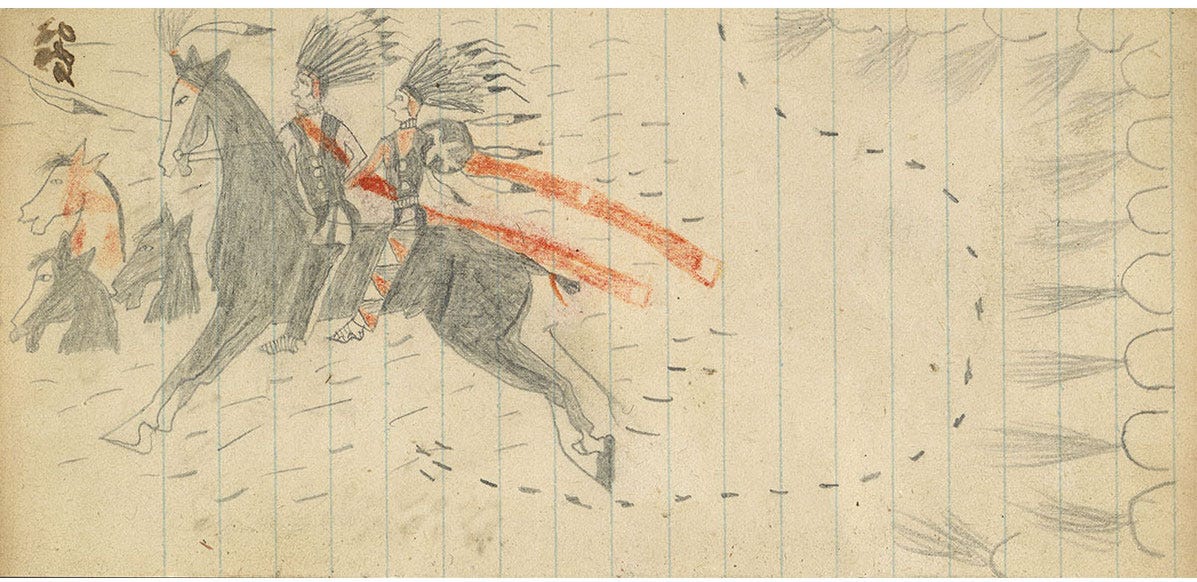
Claire Thomson, who won the 2022 Governor-General Gold Medal for Lakota history research, studied the Goodwyn Ledger drawings for her PhD, Digging Roots and Remembering Relatives: Lakota Kinship and Movement in the Northern Great Plains from the Wood Mountain Uplands across Lakóta Tȟamákȟočhe/Lakota Country, 1881-1940. This University of Alberta dissertation can be viewed and downloaded here.
Every fall, the Universities Art Association of Canada hosts a professional conference for visual arts-based research by art historians, professors, artists, curators, and cultural workers. In 2021 there was a session, F.4 ‘Fast Ponies and War Bonnets: Indigenous Ledger Drawings’, chaired by Dana Claxton, UBC, who introduced the session listing thus: There is something about the line. The artist's line, and in the case of ledger drawings, the indigenous artist line and the lines on the ledger paper itself. These cool renderings of the indigenous self, culture, life and warfare seem to exist between art, documentation, cultural aesthetics and storytelling. The panel will discuss drawing, first nations art, war art and cultural histories in reference to these 19th-century drawings.
This session F.4 lists all the abstracts for the session, worth reading as succinct summaries of some really important work.
Goodwyn Ledger Art was examined by Claire Thomson in the session, writing as an introduction: these pieces are important and unique examples in that they come from a place and historical context that no other Lakota drawings or textual art from the 1870s and 1880s have yet been placed within: Čháŋȟe, Wood Mountain (in present-day southern Saskatchewan, Canada), where Lakota people sought safety after the Battle of the Little Bighorn in 1876.
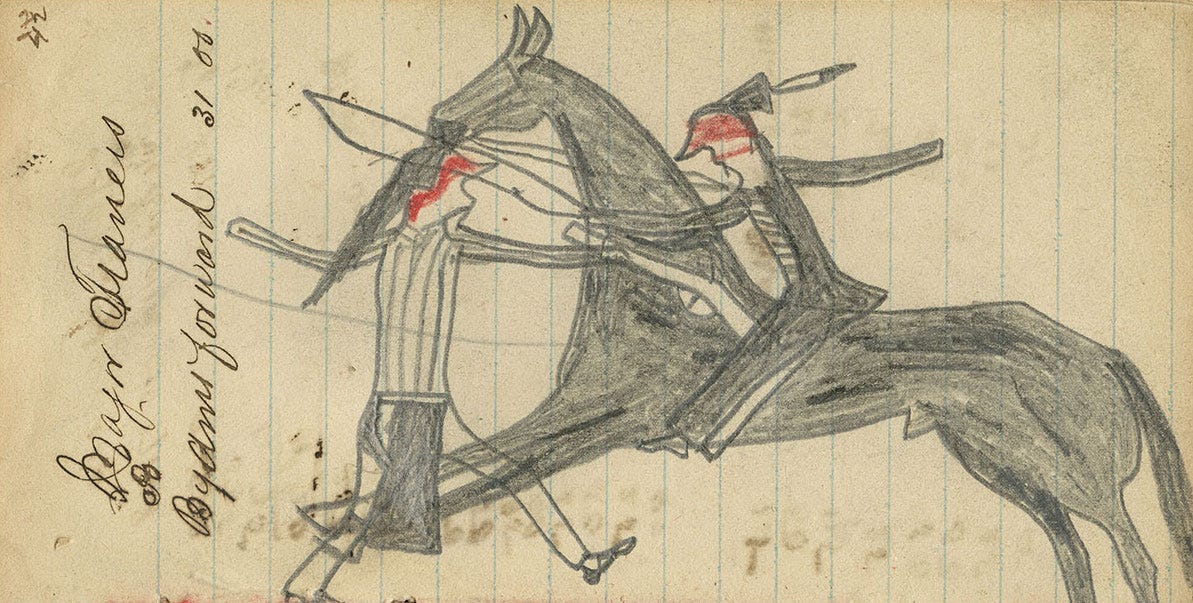
The image, above, is from Donald Ellis Gallery, a commercial New York gallery specialising in Indigenous art. How can these drawings be sold as individual pieces? According to the introduction to the Milwaukee Public Museum’s ledger drawing collection, there was a demand for such drawings: ‘Plains Indians imprisoned at Ft. Marion in St. Augustine, Florida from 1875-1878 … were encouraged to sell their work for two dollars a drawing, leading to a demand for Indian ledger art among the American middle class.’
The Red Hawk ledger book collection of the Milwaukee Public Museum consists of 105 ink and crayon drawings purchased in 1897 from H.H. Hayssen of Chuncula, Alaska. It appears to be mostly of battles between Sioux and Crow over horses, from the Sioux point of view. History drawn by the victorious. Captain R. Miller originally ‘captured’ the book from Red Hawk at Wounded Knee Creek, South Dakota on January 8, 1891, just days after the infamous massacre at Wounded Knee. Not all the drawings are by Red Hawk, or Cetanluta, and it seems that Millar added captions to the drawings. One might approach ledger drawing titles, translations and attributions as interpretive, rather than Indigenous notes.


In 2014, Trépanier Baer Gallery, Calgary, in conjunction with Donald Ellis Gallery, New York, held an exhibition of ledger drawings, Keeping Time: Ledger Drawings and the Pictographic Traditions of Native North Americans ca. 1820-1900. Monique Westra reviewed it in Galleries West, in 2014: ‘Ledger books were filled with drawings by one or more artists, often at the behest of a military officer. There’s a terrible irony in these commissions, which encouraged the recording of aspects of traditional life even as this way of life was being brutally suppressed. Compounding this irony is the fact that ledger books invariably bear the names of the non-natives who commissioned or collected them. Few intact books remain as most were unbound and sold as separate drawings.’
still here
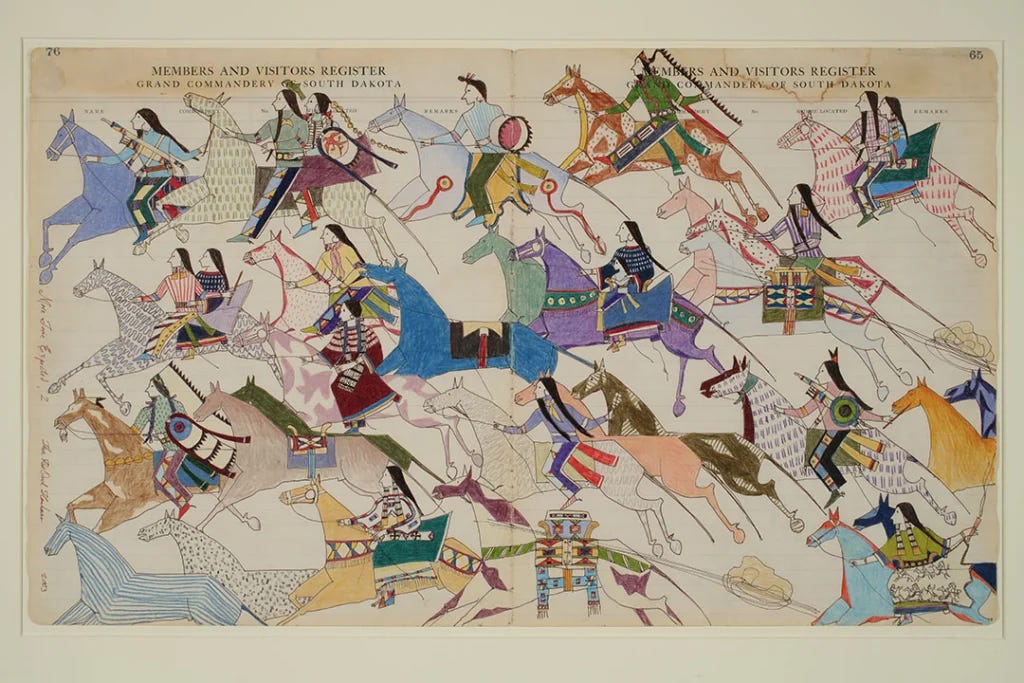
In 2020, Michelle Reynolds chose this drawing for Tacoma Art Museum’s object of the week. She wrote: ‘In More Time Expected, ledger, beadwork, and doll artist Thomas Haukaas (Rosebud Sioux Tribe) depicts more than twenty horses, with their knees bent, simulating forward movement across the picture plane. The horses vary in color and adornment with some moving alone alongside the group while others carry riders traveling solo or in pairs. At the center of the composition is a blue, riderless horse wearing a white saddle and black blanket.
The imagery, specifically the riderless horse, explores the complicated issues of stigma surrounding HIV/AIDS and the Native American experience with the disease. . . . The horse with no rider, often used as a symbol for a warrior who fell in battle, represents individuals on the reservation who have died of AIDS-related causes. By focusing on absence within a group, Haukaas plays to the importance of community and families within these settings. '
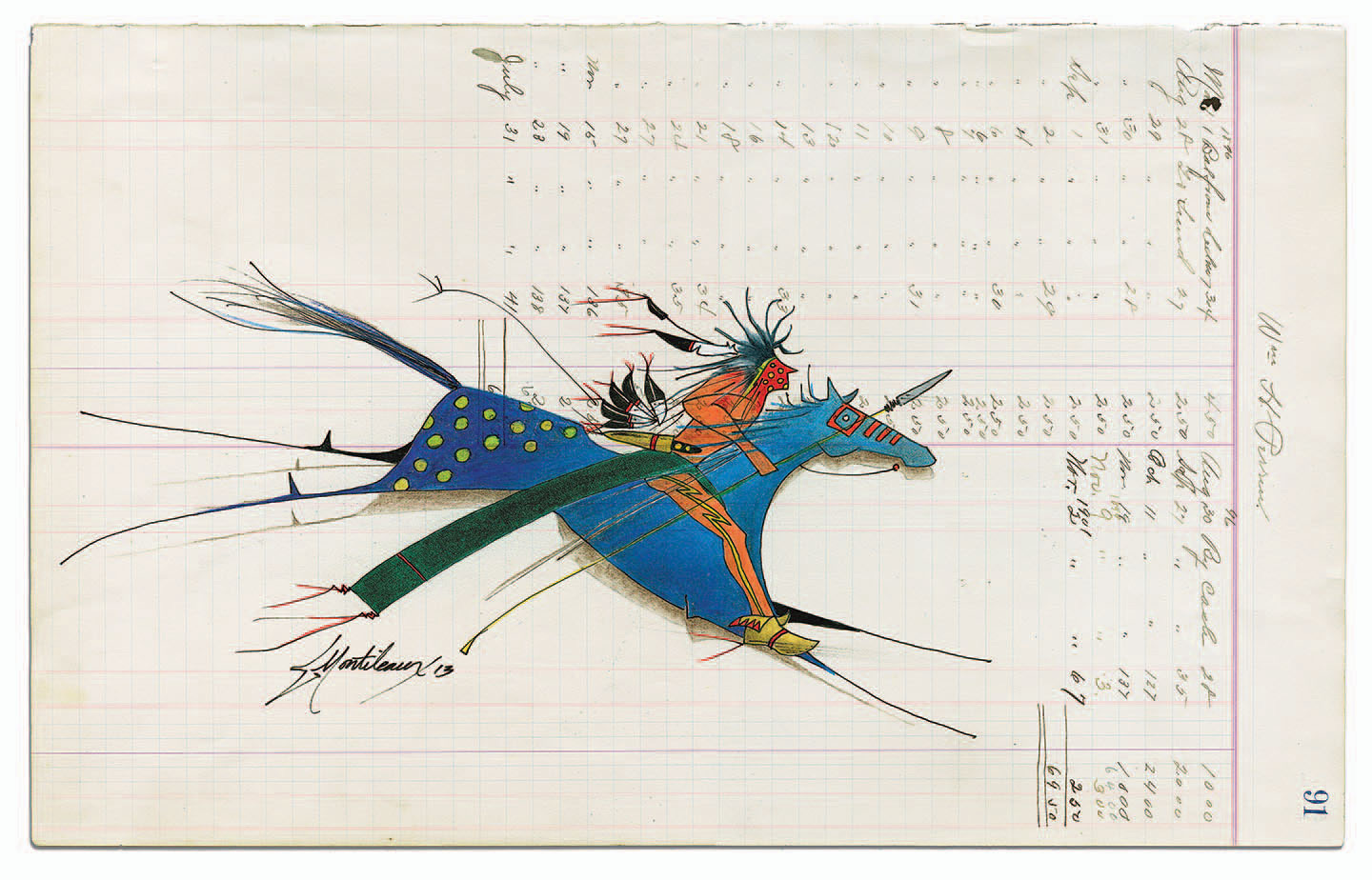
And this, from an article by Lance Nixon, 2017, in Cowboys & Indians, the Premier Magazine of the West (perhaps from Dallas), on contemporary artists in South Dakota using old ledger sheets as ground for their drawings. Donald Montileaux says of the ledgers themselves, They are the original pages. “It’s like a day of life: I got tobacco today, I got coffee, I got some eggs. Or they were loading a wagon to go up into the Dakota Territory and had blankets, barrels of sugar, flour. Most of the books that I have are of what’s being loaded off the railroad and into a store, a trading post, onto freight wagons and those freight wagons are going out into who knows where.
Another artist in this article, Terrance Guardipee, speaks about paper: ‘Paper, I think, is a very powerful thing — the way we use it and the way it was used against us, and the way I’m using it now to express myself as a Blackfeet and show the outside world the beauty and the power of my tribe. I want to express our culture by using that paper that was at one time basically an enemy of ours. It was used against us with these different treaties, with words written down on it that made promises to us. This way, I’m making promises to the world with my art but it’s through my culture — they can experience that. All the things I’m putting on the paper are true. There are no lies. The people are all people who walked on the earth and the designs are all used to this day.’
Thanks for this Stephanie. These are powerful documents. As representations, what the figures in these really remind me of, especially the horses, is the figures in the Bayoux Tapestry. The tapestry tells a similar tale of a historical defeat, but created by those who were not there. The ledgers are, in comparison, devastating.
A wonderful research into ledger art that I was not aware of until now.